
Treadmill guide
Flat vs curved self-powered treadmills
A self-powered treadmill does not have to have a curved running deck. The power source, shape of the running surface and available training modes are separate design choices. Understanding those differences helps you choose equipment for the sessions your members or clients want to do.
What self-powered means
On a self-powered treadmill, the person using it provides the movement that drives the belt. The term describes how the equipment operates; it does not tell you whether the running surface is flat or curved. It is also worth checking which electronic functions are powered by the machine itself.
The VIKON Treadmill generates the energy required for its operation, including the display and motorised incline. It needs no mains connection. That gives an operator more choice over its position within a room, while suitable flooring, clearances and delivery access still need to be considered.
Flat and curved describe the running deck
A curved treadmill has a running surface that rises towards its ends. A flat-deck treadmill has a flat profile underfoot. These shapes produce different experiences, so a practical demonstration is more useful than deciding from a photograph alone.
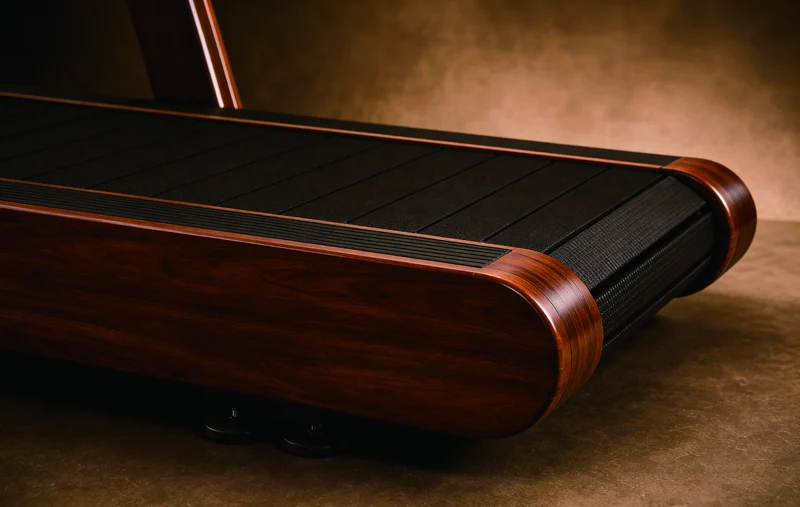
VIKON uses a flat slat-belt running deck. It is designed to give a smooth, comfortable stride and bring the feel of outdoor running indoors. That is the intended experience, rather than a claim that one deck shape is better for every runner. Try walking, a steady run and the controls at a pace that suits you.
A slat belt is different from the deck shape
A slat belt is made from individual sections that form the moving running surface. Slatted construction and deck curvature are separate features: a slat belt can be used on a flat or curved treadmill. When comparing machines, check both the surface construction and its profile.
Look at the available running area, handrail arrangement, maximum user weight and current specification. Ask how the belt is inspected and maintained. Self-powered operation does not remove the need for the care and checks described in the operating instructions.
Flat does not mean fixed at one incline
The shape of a deck is different from the angle at which the whole deck is positioned. VIKON combines its flat slat-belt surface with motorised incline up to 35%. The incline is stated as a percentage gradient, not as degrees.
The same machine supports everyday running and constant-power ERG pushing. In pushing mode, a selected watt target defines the intended workload and resistance responds within the operating range. This gives a facility three tasks to demonstrate: running, resistance pushing and incline training.
What to check in a demonstration
Start with the sessions you intend to offer, then test the equipment against that brief. A gym floor, a coached conditioning area and a private training room may have different priorities.
- Compare the running feel at appropriate walking and running speeds.
- Ask how to change modes, adjust incline and stop the equipment.
- Review the footprint, operating clearance, delivery route and maintenance instructions.
- Confirm the exact model, console, training ranges and support arrangements before ordering.
Common questions
Are all self-powered treadmills curved?
No. Self-powered describes the source of the movement and energy; it does not specify the running-deck shape. VIKON uses a flat slat-belt running surface.
Does the VIKON Treadmill need a power socket?
No mains connection is needed for the VIKON Treadmill’s operation, including its display and motorised incline. Installation still needs suitable flooring, access and operating clearance.
Does a 35% incline mean 35 degrees?
No. Percentage gradient and degrees are different ways of describing a slope. The VIKON specification states a maximum incline of 35%.